The Checkpoint That Couldn't Run: Getting Qwen-Image-2.1-Turbo Onto an M4 Pro
The ask was simple: run Qwen-Image-2.1-Turbo on my Mac, drive it from a browser, and save the workflows that work. What I got was a CUDA quickstart that cannot work on this machine, a Pillow pin that fails like a broken install, a 17.8 GB download that lies about why it failed, a concurrency bug that passed every test I wrote, and a swap wall that makes a healthy job look hung.
The short version: the model card is written for NVIDIA, and my machine is not NVIDIA. The path that works is a different runtime entirely — and the hardest bug was in my own code, not the model's.
Every command below was run on 2026-10-24 on an M4 Pro with 48 GB unified memory. Every number came off real output. The mistakes are written down so you don't have to make them.
0. Rule Zero: read the quickstart's target before planning anything
The model card opens with:
import torch
from diffusers import QwenImage21Pipeline

pipe = QwenImage21Pipeline.from_pretrained(
    "Qwen/Qwen-Image-2.1-Turbo",
    dtype=torch.bfloat16,
).to("cuda")
Two words decide this whole project: .to("cuda").
My machine:
$ uname -m
arm64
$ sw_vers
ProductVersion: 26.6.2
There is no CUDA on arm64 macOS. Not "it's slow" — it does not exist. And the weights that card expects are 32.5 GB of bf16:
text_encoder/model.safetensors                          17.534 GB
transformer/diffusion_pytorch_model-00001-of-00002...    9.968 GB
transformer/diffusion_pytorch_model-00002-of-00002...    4.262 GB
vae/diffusion_pytorch_model.safetensors                  0.676 GB
                                                     ------------
                                                     32.49 GB total
So the card's path is closed twice over: no CUDA, and a 32.5 GB footprint. I still have 51 GB free on disk, but I did not want to spend it on a path I could not execute.
The lesson, and it is the whole post in one line: a model card documents the author's environment. Check it against yours before you plan disk, memory, or timing around anything in it.
1. Find the conversion before you plan anything
Hugging Face hosts two different MLX ecosystems, and they are not interchangeable. Searching the orgs:
curl -s "https://huggingface.co/api/models?author=mflux-community&limit=100"
curl -s "https://huggingface.co/api/models?author=mlx-community&limit=100"
What exists:
| Shape | Example | Notes |
|---|---|---|
mflux-community/<model>-mflux-q<N> | qwen-image-2-1-turbo-mflux-q8 | Pre-quantized for the mflux runtime. Load with quantize=None. |
mlx-community/<model>-MLX-4bit | Qwen-Image-2.1-MLX-4bit | Diffusers-format MLX weights. Often a repack of the base, non-distilled checkpoint. |
Two things I got wrong on the first pass, both worth recording:
mlx-community/Qwen-Image-2.1-MLX-4bitis the wrong checkpoint. It is 10.5 GB and it is the base model — 40 steps, no distillation. The card advertises Turbo's 8 steps. A third-party recipe explicitly warns against it: "Not recommended: it quantizes the text encoder to 4-bit, which mflux itself refuses to do."- There is no
mlx-communityTurbo at all. I checked three plausible names; all 401. The Turbo conversion lives inmflux-community, notmlx-community.
The one I want:
mflux-community/qwen-image-2-1-turbo-mflux-q8
  transformer/0..3.safetensors     7.66 GB
  text_encoder/0..4.safetensors   9.35 GB
  vae/0.safetensors               0.68 GB
                               ----------
                               17.79 GB total
Same architecture, same saved 8-step schedule, half the disk, and it runs on
Metal. Its README says the quantization level is stored in the weights, so
--quantize is not needed — which also skips a re-quantization pass over 32 GB.
2. Choose the quantization by free disk, not by the card
The card quotes bf16. The runnable size is the quantized one, and the levels differ by gigabytes:
| Quant | Size | Repo |
|---|---|---|
| bf16 | ~33 GB | ...-mflux-bf16 |
| q8 | 17.8 GB | ...-mflux-q8 |
| q6 | ~14.5 GB | ...-mflux-q6 |
| q5 | ~12 GB | ...-mflux-q5 |
| q4 | ~10 GB | ...-mflux-q4 |
Fetch the real byte counts rather than trusting a table:
curl -s "https://huggingface.co/api/models/<repo>?blobs=true" \
  | python3 -c "import sys,json
d=json.load(sys.stdin)
print(sum((f.get('size') or 0) for f in d['siblings'])/1e9, 'GB')"
I took q8. On a 48 GB machine, an 18 GB model leaves room for activations; q8 is also the level the model's own documentation recommends when memory is tighter than a 64 GB box. q4 would have been 7 GB lighter but the quality cost is real, and I had the disk.
3. The install, and a Pillow pin that fails like a broken install
uv venv --python 3.13 .venv
uv pip install --python .venv/bin/python mflux fastapi uvicorn python-multipart "pillow==12.3.0"
Python 3.13, not 3.12 — mflux's dependency graph resolves differently there.
Then this, which cost me two attempts:
$ .venv/bin/mflux-generate-qwen-2.1-edit --help
  File ".../PIL/_typing.py", line 8, in <module>
    from numbers import _IntegralLike as IntegralLike
ImportError: cannot import name '_IntegralLike' from 'numbers'
Pillow 13.0.0 imports numbers._IntegralLike, a private name that does not
exist in Python 3.12 or 3.13. The traceback points at PIL/_typing.py, which
reads like a corrupt Pillow rather than a pin you forgot — and it kills every
mflux CLI entry point, not just the one you called.
Pinned to 12.3.0, the CLI works. This is now the first line of the README.
4. Downloading 17.8 GB: it stalls, and the error lies
First attempt, plain hf download:
Still waiting to acquire lock on .../.gitignore.lock
EXIT=0
 23M  models/qwen-image-2.1-turbo-q8
Zero progress. It was not slow — it was stalled, and it sat there for minutes while I assumed the network was bad. Measuring bytes over a window is the only way to tell:
A=$(find models/... -name "*.incomplete" -exec stat -f "%z" {} \; | paste -sd+ - | bc)
sleep 30
B=$(...)
echo "rate: $((B-A)) bytes in 30s"
A stalled run makes zero progress and must be restarted, not waited on.
With the Xet transfer backend it runs properly:
HF_XET_HIGH_PERFORMANCE=1 HF_HUB_DOWNLOAD_TIMEOUT=600 \
  .venv/bin/hf download mflux-community/qwen-image-2-1-turbo-mflux-q8 \
  --local-dir models/qwen-image-2.1-turbo-q8
(Note: HF_HUB_ENABLE_HF_TRANSFER is deprecated as of huggingface_hub 1.33 —
the replacement is HF_XET_HIGH_PERFORMANCE. The old variable still works but
warns.)
Then verify. This is the step that saved the next hour:
$ .venv/bin/python scripts/verify_weights.py
  files checked: 25, problems: 0
  total on disk: 17.79 GB
  OK — weights match the hub exactly.
Why it matters: a truncated shard does not fail during download. It fails later at model-load time with:
FileNotFoundError: No safetensors files found in .../vae
which reads like a bad path rather than a bad download. Comparing local sizes against the hub tree API catches it in ten seconds. Both scripts are in the repo.
5. Building the studio
The model is a library, not a service. A browser needs three things: a job registry, a worker, and something to poll.
backend/
  app.py      # FastAPI routes
  engine.py   # model cache, job registry, worker thread, progress sink
  ui.html     # one file, no build step
POST /api/generate takes multipart fields plus images[] and an optional
mask, creates the job synchronously, and returns an id. The UI polls
GET /api/jobs/{id}. Generation is serialized — Metal is one GPU.
Two variants share one checkpoint directory; the ModelConfig selects the
Turbo schedule:
| Mode | Variant | Extra kwargs |
|---|---|---|
| text → image | QwenImage21 | width, height |
| image → image | QwenImage21 | image_path, image_strength |
| reference edit | QwenImage21Edit | image_paths, output_resolution, strength |
| inpaint | QwenImage21Edit | image_paths, mask_image |
Three details that were not obvious:
- Reference order is significant. The first image is the edit source; the rest are additional references (subject + scene).
- Inpaint needs a source image. Without a server-side check it silently falls through to a text-to-image run and you get a picture instead of an edit.
- Turbo rejects CFG.
Qwen21TurboScheduler.check_generateraises unlessguidance == 1.0. The UI disables the guidance field rather than letting you hit the error.
6. The bug that passed every test I wrote
I ran a text-to-image job. It worked. I ran a reference edit. It worked. I ran a second text-to-image. It failed:
RuntimeError: There is no Stream(cpu, 9) in current thread.
RuntimeError: [METAL] Command buffer execution failed:
               Caused GPU Timeout Error (00000002:kIOGPUCommandBufferCallbackErrorTimeout).
My code spawned a thread per request:
job_id = engine.new_job(params)
threading.Thread(target=engine.run, args=(job_id,), daemon=True).start()
MLX Metal streams are thread-local. The first job creates and evaluates
the model on the same thread — fine. Every later job reuses the cached model
from a different, now-dead thread, and mx.eval refuses. The GPU timeout in the
same run is that corruption, which is why it looked like a hardware fault and
sent me chasing memory.
The reason this shipped: each of my tests was the first successful job in its own process. A test suite that runs one job per process passes. The bug only appears on the second job in a long-lived server — which is exactly the situation a user hits and a test does not.
The fix is one worker thread behind a queue:
def submit(self, params):
    job_id = self.new_job(params)
    if self._worker is None or not self._worker.is_alive():
        self._worker = threading.Thread(target=self._worker_loop, daemon=True)
        self._worker.start()
    self._queue.put(job_id)
    return job_id
Verified by running three jobs back-to-back through the running server — the second one being the exact case that failed:
| # | Job | Wall time |
|---|---|---|
| 1 | text → image (includes model load) | 97.3 s |
| 2 | text → image, cached model | 173.3 s |
| 3 | reference edit | 139.3 s |
7. The swap wall: a healthy job that looks hung
Job 2 took 173 s where job 1 took 97 s for identical work. The cause was not the code:
$ sysctl vm.swapusage
total = 28672.00M  used = 27661.38M  free = 1010.62M
$ ps aux | awk '{s+=$6} END {print s/1048576 " GB total RSS"}'
12.2 GB total RSS
Live processes accounted for 12 GB. Swap held 27 GB — macOS had evicted the idle model weights. The tell is unmistakable once you know it: flat RSS at ~0–3% CPU for over a minute means thrashing, not computing.
Kill the job and memory returns immediately; a retry succeeds. Closing Chrome and Slack before a batch is the bigger lever — an 18 GB model plus a desktop environment on 48 GB is a real constraint, not a hypothetical.
8. What it actually produces
Structural checks prove a file exists. Only looking at it proves the file is right. Three real outputs from this session:
- Text → image — "a red panda reading a book under a cherry tree, watercolor illustration" → a red panda holding an open book under cherry blossoms, watercolor. Correct.
- Text → image — "a lighthouse on a cliff at sunset, oil painting" → a lighthouse on a grassy cliff over the ocean at golden hour, painted. Correct.
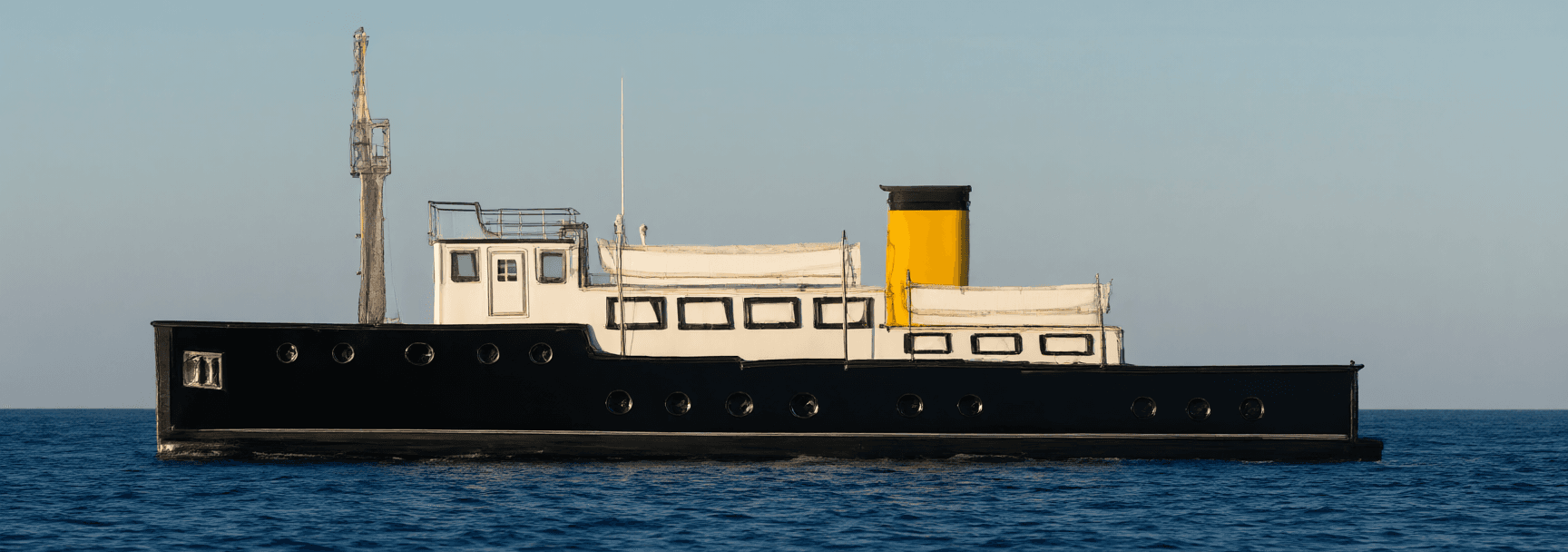
- Reference edit — the model card's yacht sketch → a photorealistic yacht with a black hull, white superstructure and yellow funnel on deep-blue water. Correct.
That third one is the hero image at the top of this post. It is a real output from the setup described here, not a stock photo.
Measured on the M4 Pro, Q8, 1024×1024:
| Per denoise step | ~11 s |
| First generation (with load) | ~111 s |
| Cached | ~97 s |
| Reference edit | ~139 s |
9. What I'd tell an agent to do differently
If you are going to replicate this, start here:
- Check the runtime before the model.
.to("cuda")on arm64 macOS is a dead end. Find the MLX conversion first, then plan. - Search both orgs.
mflux-community(pre-quantized, mflux runtime) andmlx-community(diffusers-format) are different things, and the checkpoint you want may only exist in one. - Measure, never assume, a download. Zero bytes over a 30 s window is a stall. Restart it.
- Verify weights against the tree API before the first load. The failure it prevents looks like a bad path.
- Pin
pillow==12.3.0. The error points atPIL/_typing.pyand misleads. - One worker thread. Not a lock around a shared thread — one long-lived thread behind a queue. Thread-local Metal streams make anything else break on the second job.
- Test the second job in the same process. Every bug in section 6 was invisible to a one-job-per-process test.
- Read swap before reading the code. Flat RSS and ~0% CPU is thrash.
10. The repo
Everything is at github.com/kliewerdaniel/qwen-image-studio.
The weights are not committed — 17.8 GB is not a git problem, and they carry
their own license. scripts/fetch_weights.sh downloads them and
scripts/verify_weights.py checks them. The repo is 13.86 MB across 17 files,
with zero safetensors.
git clone https://github.com/kliewerdaniel/qwen-image-studio.git
cd qwen-image-studio
uv venv --python 3.13 .venv
uv pip install --python .venv/bin/python mflux fastapi uvicorn python-multipart "pillow==12.3.0"
./scripts/fetch_weights.sh
./start.sh          # → http://127.0.0.1:8787
The three seeded workflows — sketch to photorealistic, style transfer, object
swap — are in workflows/ as JSON and load straight into the UI.
One license note, and it is not a footnote. The weights are under the Qwen Research License Agreement: non-commercial use only. Section 1.i defines "Non-Commercial" as "for research or evaluation purposes only", and Section 2.a grants the license "FOR NON-COMMERCIAL PURPOSES ONLY". The code is MIT. If you want to use the model commercially, that is a separate license from the licensor.
The studio is local-first: prompts, images and outputs never leave the machine. The only network call is fetching the weights.
Related research
Oct 23, 2026
Two Models, One Harness: Swapping Flint for Gemma 4 Without Losing Either
A complete, verified log of choosing a new local model to drive Hermes on an Apple M4 Pro, and getting it to coexist with the model already running. Covers surveying what actually exists on Hugging Face, verifying a GGUF header before a 17 GB download, the two llama-server flags gemma4 refuses to run without, an out-of-memory wall that turned every request into a 500, why a 4B dense model can cost more GPU memory than a 26B mixture-of-experts, a speed measurement that broke my own claim, and the launchd switch that lets both models stay available. Every command was run. Every number came off real output.
Oct 22, 2026
Hoisting Recursive Flint Aboard Hermes: A Pirate's Guide to Running a 40B MoE Locally
A complete, verified log of running Recursive's 39.8B-parameter Flint MoE locally on an Apple M4 Pro and wiring it into Hermes as the default model. Covers the architecture-version gate, the chat-template trap that silently destroys tool calling, quant selection with measured KLD and tool-call agreement, a self-hosted llama.cpp install, launchd persistence, and every measured number. Written so an agent can repeat it without making the same mistakes.
Oct 23, 2026
The Trust Store Nobody Patched: A Log of Patching eMudhra, Node.js, and a Lie in npm Audit
A complete, verified log of responding to the October 2026 security advisory: the eMudhra certificate compromise, the Node.js security release, and PHP2Shell. Covers mapping a hosting-provider advisory onto a real stack, the grep that lies about certificate trust stores, proving a runtime is vulnerable by decoding its bundled roots, pinning a Node version, a fail-closed build-time gate that refuses to compile on an unpatched runtime, a 20-test suite that is mutation-checked, and the critical Next.js RCE hiding in a routine npm install. Every command was run. Every number came off real output.
Oct 11, 2026
Building a Rust-Native Creative Suite on Apple Silicon: A Complete, Verified Installation
The complete build, launch, and verification record for the Rust-native creative suite — 8 applications, all written in Rust, all native Apple Silicon, all built from source on a MacBook Pro M4 Pro. Every command was run. Every number is real.
More from the archive
- Oct 23, 2026LLMjacking: Building the 'Skynet Mode' Recursive Attacker
- Oct 23, 2026Operation Ouroboros: The Recursive Intelligence Parasite
- Oct 12, 2026MindBroadcast — A Technical Specification for a Persistent, Autonomous, News-Driven Intelligence and Broadcasting System
- Sep 26, 2026Omarchy on a 2017 MacBook Pro: A Setup Retrospective