
The book · Hardcover · $88
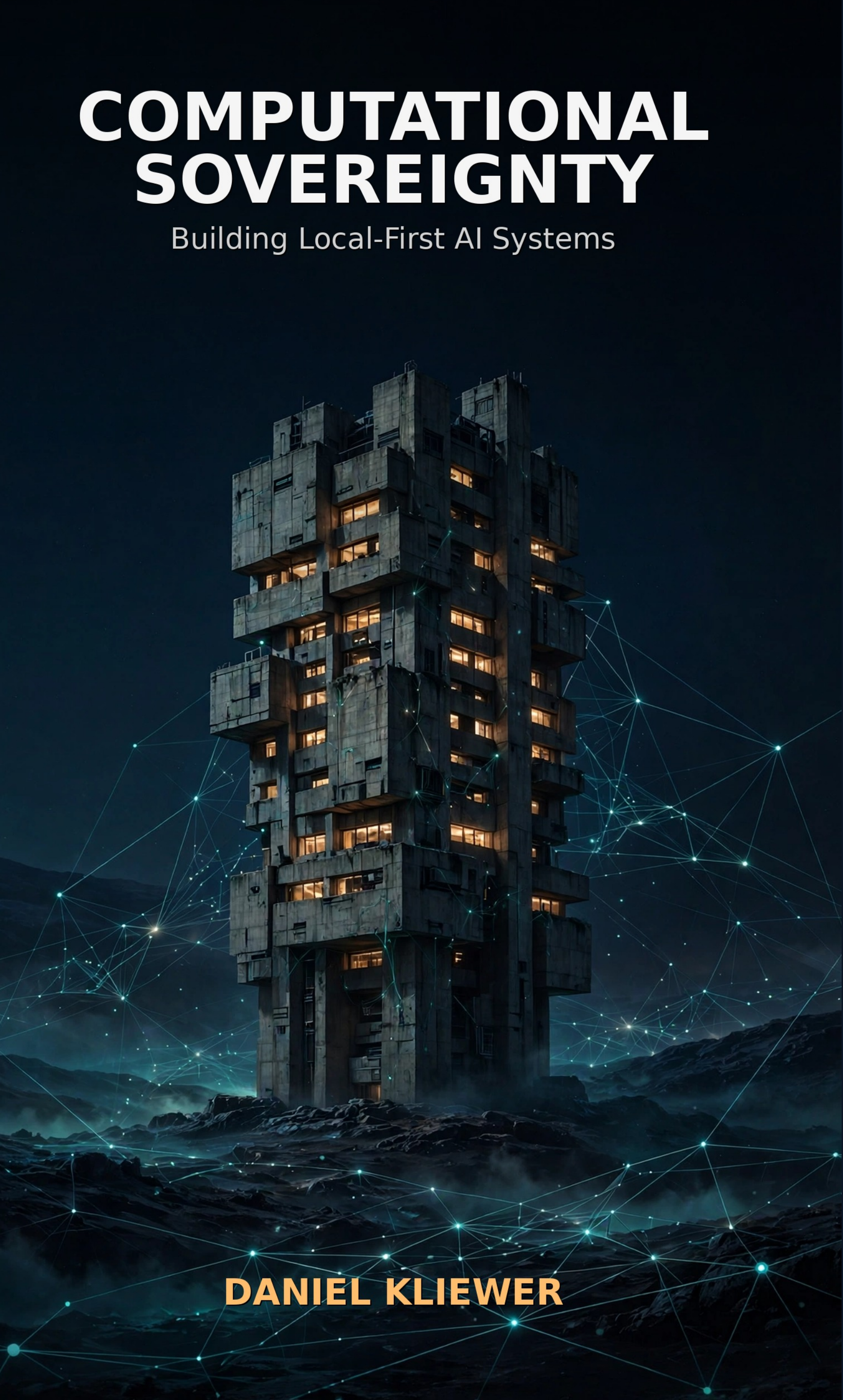
Computational Sovereignty
Building Local-First AI Systems
Most AI engineering in 2024–2026 was integration work: call someone else's model, parse the output, hope the weights don't change overnight. This book is about the other discipline — building the whole stack on machines you own, where every behavior is reproducible and every number is yours.
It starts by pricing the cloud as a liability and ends with a practice for shipping sovereign software. In between: 24 chapters of models, retrieval, graphs, agents, personas, and verification — each one measured, each one runnable.
The argument
Eight parts, one thesis
Each part makes a single claim and then spends three chapters proving it with working systems.
PART I — WHY SOVEREIGNTY
The cloud is a priced liability, and the stack you need to replace it is five layers tall.
PART II — INFERENCE YOU CONTROL
Tokens, sampling, and model selection are engineering decisions with measurable consequences — treat them that way.
PART III — MEMORY THAT ISN'T A PROMPT
Retrieval is only as honest as its evaluation. Build the gold set first, then believe your numbers.
PART IV — KNOWLEDGE GRAPHS
Reason once, compile the result. A knowledge graph is a decision you made ahead of time.
PART V — AGENTS THAT OBEY
An agent without a state machine is a rumor with tool access. Govern the transitions or inherit the incidents.
PART VI — PERSONAS AND ROUTING
Personalities can be quantified, and routing between specialists beats one generalist — measured, not asserted.
PART VII — VERIFICATION DISCIPLINE
Refusal is a feature, contradiction is data, and benchmarks are frozen or they are fiction.
PART VIII — PRIVACY, SECURITY, SHIPPING
Air-gapped systems have a security model, shipping has a checklist, and the practice compounds.
Table of contents
Twenty-four chapters, eight parts.
Each part builds on the one before it. Every chapter ends with something running on your own machine.
I — Why Sovereignty
II — Inference You Control
III — Memory That Isn't a Prompt
IV — Knowledge Graphs
V — Agents That Obey
VI — Personas and Routing
VII — Verification Discipline
VIII — Privacy, Security, Shipping
Specifications
The physical facts
- Title
- Computational Sovereignty: Building Local-First AI Systems
- Format
- Hardcover · 6×9 in
- Pages
- 214
- Chapters
- 24 chapters · 8 parts
- Words
- ~46,000
- Price
- $88
- Author
- Daniel Kliewer
Questions
Asked and answered
Do I need a GPU?
For the serious chapters, yes — 24GB of VRAM or a Mac with unified memory is the entry ticket, and chapter 1 says so up front. The early chapters run fine on a CPU so you can start before the hardware arrives.
Is this just anti-cloud ideology?
No. Chapter 1 lists exactly when the cloud is the right call — frontier capability, tiny bursty workloads, no operational capacity — and prices the rest as a liability. The position is default-local, not never-cloud.
What skill level does it assume?
Comfort in a terminal, working Python, and no fear of a config file. It does not assume ML training experience — it does assume you have shipped software and been paged for it.
How is this different from the blog?
The 198 research posts are the laboratory: experiments, measurements, dead ends. The book is the compiled artifact — the reasoning done once, organized so you don't have to rediscover it across three years of archives.
Ebook or paperback?
Hardcover only. 214 pages, 6×9 in, built to live on a desk next to the machine it describes. There is no DRM to strip because there is no DRM.
When does it ship?
The manuscript is complete and reviewed — 24 chapters, ~46,000 words. The hardcover is live on Amazon now, so the button below is the real listing, not a placeholder.
24 chapters · ~46,000 words · $88
Own every layer.
The cloud will still be there when you need it. After this book, you'll know exactly what each API call costs you — and you'll have the machine to replace it.
Buy the hardcover — $88 ↗