
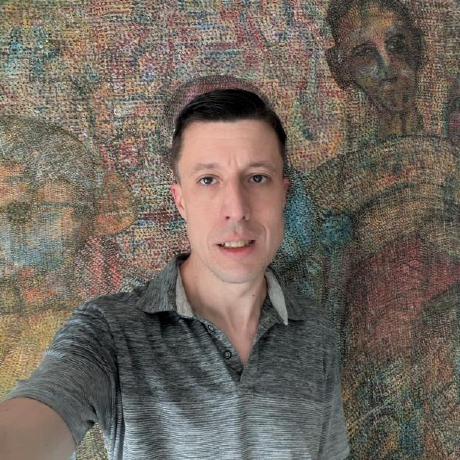
Daniel Kliewer
AI engineer. Search relevance, local-first systems, and twenty years of painting.
Austin, Texas · 2006 — present
Currently
What I actually do
Local-first AI systems
I build systems that run on hardware I own — local inference, retrieval evaluated against frozen sets, knowledge compiled into graphs before query time, and agents whose authority sits in a deterministic substrate rather than in the model's judgment. The code is public; so are the measurements and the dead ends.
Search quality, one level up
I also contract on search-quality evaluation — the Page Quality and Needs Met frameworks — work that asks whether an output deserves to be surfaced at all. It is the same question I spent a decade on at Amazon, applied to machine-generated claims instead of web pages.
Writing it down
The synthesis is Computational Sovereignty: 24 chapters on building systems you can own, audit and reproduce. The working notes are the research log — 198 posts published as the work happened, including the parts that failed.
Record
How I got here
History, and a plan to study law
Began a BA in History at the University of Mary Hardin-Baylor, on a course of study aimed at law school. Finished in 2007. I did not go.
Painting, then painting with televisions
Figurative and experimental time-lapse oil painting. Then a stranger version: old televisions wired through modulators to refurbished computers, painting on a Wacom tablet in Photoshop, capturing the screen, cutting the result in After Effects. Shown at Co-Lab Space in Austin in March 2012 as 'possible and remembered time'.
Machine learning, self-employed
Started taking ML work under my own name — retrieval systems, human-in-the-loop annotation platforms, and later agent frameworks. Still doing it.
A decade of search at Amazon
Ten years in Austin on keyword research, competitive analysis, content optimization and behavioural data. The work was measuring whether information actually satisfied the query — relevance as a measurable property rather than a vibe. This is where the question that runs through everything else came from.
A two-hour film that turned televisions into a moving painting
Screen capture, Photoshop and a Wacom tablet, assembled into an experimental film and shown at Austin Film Society's Avant Cinema program in October 2012. Around the same period I built danielkliewer.com, kadaligogh.com and eastsidechess.org.
The MIT curriculum, without the enrollment
MIT publishes its course materials free through OpenCourseWare. From 2017 to 2021 I worked through the computer science curriculum that way — lectures, problem sets, exams — at the depth of a degree and with none of the credential. No enrollment, no credit, no degree. The material is what I was after; the credential would have been someone else's signature on my work.
The research log goes public
Publishing as the work happens — 221 public repositories on GitHub since 2014, and a post for most things that worked, plus the ones that didn't.
Computational Sovereignty
24 chapters, 214 pages. The laboratory years compiled into a single artifact.
Positions
What I believe
A system you can't reproduce isn't engineering
It's a demo with good lighting. Determinism, measurement and ownership aren't aesthetic preferences — they're the difference between infrastructure and luck. This is why the projects publish their tests and their failures alongside their results.
The cloud is a priced dependency, not a default
Price it explicitly, the way you'd price anything that can change its behaviour, its cost or its availability without telling you. Sometimes the price is fine. Often it's the largest line item in a system nobody is accounting for.
Breadth is not a distraction
Painting taught me to finish things that have no specification. Search taught me to measure whether a thing was worth surfacing. Machine learning taught me that both of those are the same problem wearing different clothes.
Earlier work
Also by Daniel Kliewer
Paperback · 72 pages
Sovereign AI
An Architectural Investigation into Local-First Intelligence